
One Year On from the ICJ Climate Ruling: The Pacific, the World Court, and the Road Ahead
23, July 2026
PRESS RELEASE
PRESS RELEASE
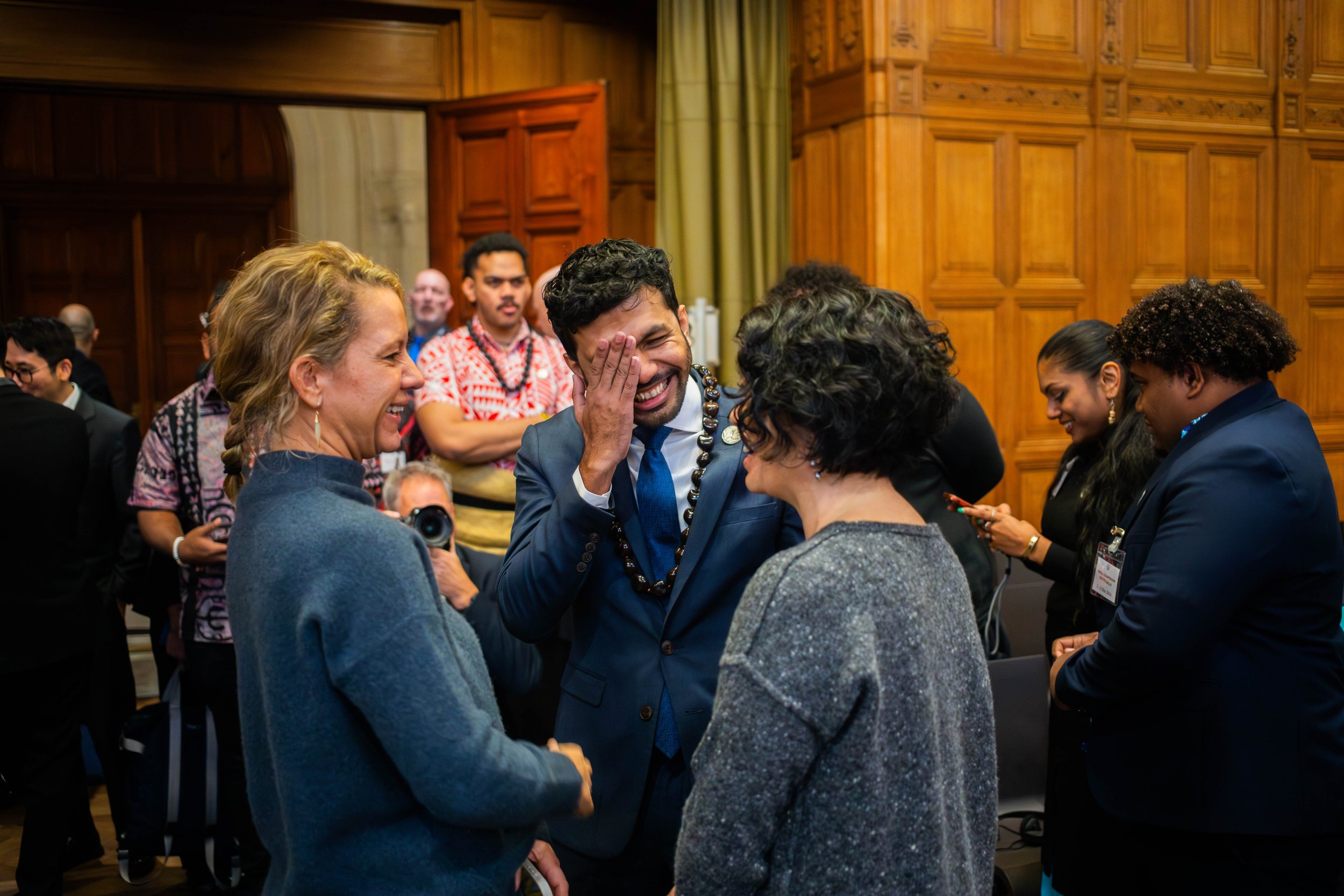
Exactly one year ago, the International Court of Justice, the world’s highest court, delivered its landmark Advisory Opinion on climate change - a historic milestone that reshaped the global conversation on climate justice. This achievement was a victory for international law and also a testament to the transformative power of Pacific leadership, in particular of its youth. What began as an idea championed by twenty seven Pacific law students grew into a global movement because young people have worked hand in hand with governments, civil society organisations, stakeholders and countless allies who believed that climate justice could be pursued through international law. Together, they demonstrated that when youth are meaningfully engaged as partners in decision making, they can help drive change at the highest levels of global governance.
The journey to The Hague was long-fought and it was Pacific-led from the very beginning. The question posed by the young law students – could the world’s highest court rule on climate obligations? – essentially turned into more than just a student-led initiative. It became a Pacific-wide movement and was later carried forward by Vanuatu and other Pacific nations who championed the call for an advisory opinion at the United Nations General Assembly and staunchly stood behind it until it reached the doors of the International Court of Justice at The Hague.
Since the landmark climate ruling, the Pacific has continued to lead the way, this time, to call for the Advisory Opinion’s implementation. In the last year alone, the Advisory Opinion has been cited in court cases around the world and used as legal grounds to increase pressure on fossil fuel companies, drilling companies, and more. It is an authoritative confirmation that states have legally binding obligations to prevent further climate harm and to protect our shared climate system. The obligations outlined in the Opinion are not aspirational goals, they are grounded in firm existing commitments and law and are backed by extensive technical and scientific evidence. The Opinion goes beyond confirming States’ legal obligations, it also affirms that breaches carry real legal consequences and reparations, meaning states that fail to act can be held legally accountable for their inaction to protect the climate. The Opinion also affirms that 1.5°C is the legally recognised temperature limit that states must act to uphold.
"The ICJ used scientific findings which were very clear that climate change is dangerous, that there is not much time left, and there’s all these irreversible harms that have already occurred," said Alofipo So’oalo Fleur Ramsay, International Indigenous and Human Rights Lawyer, at PISFCC’s Webinar to celebrate the one year anniversary of the Advisory Opinion. "We need the most progressive interpretation of this ruling — and of the climate litigation still ahead — so the Advisory Opinion is not undermined."
In May 2026, the United Nations General Assembly adopted a follow-up resolution to operationalise the Advisory Opinion – once again, spearheaded by Vanuatu and Pacific partners. With the resolution in place, we now look ahead to transform climate law into real, tangible action.
"The Advisory Opinion was about unity, not individual agendas. It was about a collective. It proved that when a movement is anchored in unity, humility, and peace, and shared survival, no tide could turn it back" said Shiva Gounden, Head of Pacific at Greenpeace Australia Pacific. "The Court affirmed what frontline communities had been pushing for, that the destruction of our climate is not just a natural tragedy, it is a profound and actionable injustice. The law and the science are finally standing on the same ground…and the landslide vote for the UNGA resolution shows political will is finally catching up."
“One year on, the Advisory Opinion is not just any ordinary document, it is a living instrument that has the power to protect our climate for us now, and for the generations to come.” said Vishal Prasad, Director at Pacific Islands Students Fighting Climate Change. “Our journey started far in a small classroom at the University of the South Pacific. Since those moments, we have watched this movement for climate justice evolve and take steps into the International Court of Justice, into courtrooms around the world, to negotiating spaces, and to communities all over. Opportunities like these are all thanks to law finally catching up to science and to the lived realities of our people and the work of all our friends and allies who continue to stand beside us. Our work now is to make sure we keep up the momentum and start implementing.”
While we celebrate the Advisory’s Opinion first anniversary, we understand that states’ legal obligations do not expire with the anniversary of the ruling and that with every new year, obligations must sharpen with greater action and accountability.
"The Advisory Opinion is now an overlay on how the line is held — on science, on ambition, on 1.5°C. When Pacific Islands and our allies show up now, they show up with a different kind of strength behind them," said Dr. Sindra Sharma, International Policy Lead at PICAN.
"There is no exit ramp. A state cannot negotiate its way out of a legal obligation by weakening a COP text," added Dr. Sivendra Michael, Permanent Secretary for Fiji’s Ministry of Environment and Climate Change. "Our message is [simple: move from ambition to implementation, not language that lets you evade responsibility.] The Pacific will not accept another decade of [climate inaction.]"
PISFCC, alongside Pacific youth from all over, civil society organisations, and partners, will continue to utilise the Advisory Opinion as it was intended, as a tool for accountability not just in courtrooms but at the UNFCCC, at negotiating spaces and convenings, and in every space where the future of the Pacific and the planet is being decided. The voyage that started with the twenty-seven young law students from the University of the South Pacific continues to traverse our vast oceans, carrying with it a movement that has not and will never slow down.
– END –
About PISFCC
The Pacific Islands Students Fighting Climate Change (PISFCC) is a youth-led organisation established in 2019 by 27 law students at the University of the South Pacific. Confronted by the inadequacy of political action on a crisis that threatens the existence of our nations, we launched a campaign to seek an Advisory Opinion from the International Court of Justice on States' obligations in respect of climate change.
That campaign persuaded the Government of Vanuatu to lead it, built a cross-regional coalition of States, and secured a UN General Assembly resolution by consensus in March 2023 requesting the Opinion. On 23 July 2025, the Court delivered a robust and comprehensive ruling on climate change - unanimously. In May 2026, the General Assembly endorsed it by 141 votes to 8. PISFCC is the organisation that started this, and it has stayed with it at every stage: the written and oral proceedings, the mobilisation around delivery, and now leads the campaign to operationalise the Advisory Opinion to realise climate justice for Pacific peoples.
Pacific Islands Students Fighting Climate Change (PISFCC) is a Pacific youth-led climate justice organisation born from a classroom of law students at the University of the South Pacific and later moving into spaces such as The Hague, The United Nations, COPs, and more. PISFCC continues to champion Pacific youth leadership in international climate governance and looks to achieve a climate-just future for all by working to.
Media Contact
Francine Valmaria Elisaia | Digital Media Lead | francine@pisfcc.org | +685 7526986